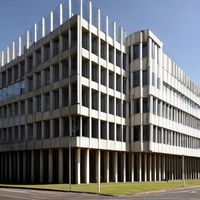
A distinguished university structure, celebrated for its architectural excellence and accolades, is facing demolition barely three decades after its construction, a decision that has drawn significant backlash. The Centenary Building, commissioned for Salford University in the north of England, was the recipient of the esteemed Royal Institute of British Architects (RIBA) Stirling Prize in 1996, an honor that designates the finest new architectural creation in Britain. Despite this, the institution has confirmed the impending demolition of the structure, which has remained unoccupied for several years.
In a statement provided on Tuesday, the university justified the decision, citing the building's outdated infrastructure as incompatible with contemporary benchmarks and needs. "The Centenary Building, while a fixture of our university's property for many years, regrettably, its aging infrastructure no longer aligns with modern-day standards and demands," the university's statement read. It further noted that the building has been vacant for a significant portion of its existence, and the demolition is part of an extensive revitalization plan for the area.
Stephen Hodder, the architect behind the Centenary Building, expressed his profound disappointment in a statement sent on Tuesday. "My dismay is not merely sentimental, stemming from it being the first-ever RIBA Stirling Prize winner, nor is it due to the building's significance in the evolution of our practice," Hodder stated. "I am fundamentally opposed to the demolition of a structure that is merely three decades old. There must be a serious consideration of the carbon emissions that will result from its demolition and subsequent replacement," he emphasized. Hodder argued that "aging infrastructure" should not be a reason for demolition, as it can be modernized or replaced. "For an institution that champions its sustainability efforts, the plan to demolish seems to contradict its policy's credibility. We strongly encourage a reassessment," he urged.
In October, the Twentieth Century Society, an advocacy group dedicated to the preservation of 20th-century architecture in the UK, submitted a listing application to Historic England, a public body responsible for the stewardship of the nation's heritage environment, in an attempt to safeguard the building. The building, constructed with concrete cross-wall technology, is organized around an internal 'street' with educational and administrative spaces on either side, connected by galleries and bridges, as described in the application announced on October 31.
The society's proactive listing application was a response to concerns that the rapid redevelopment of the surrounding area could jeopardize the building's future. In a statement on Tuesday, the society expressed its deep disappointment that efforts to repurpose the building as a school or community center had fallen through, leading to its scheduled demolition. "This would be an entirely irresponsible and unnecessary outcome, and we implore the university to reconsider," the statement read. "The building is a sophisticated example of modern architecture with clear potential for adaptive reuse." The society added that the building had previously catalyzed regeneration in the area and could do so again.
Jack Pringle, the chair of the RIBA board, stated that while the organization could not comment on the Centenary Building specifically, the creative reuse of buildings is essential for achieving a net-zero future. "Secondly, there should be a case for considering all Stirling Prize-winning buildings for listing," Pringle said in a statement on Tuesday. "By definition, they represent the best buildings of their year, and it would not be unreasonable to list at least one modern building per year, after due consideration and perhaps allowing some time to pass."
The impending demolition of the Centenary Building has sparked a broader debate on the value of architectural heritage and the responsibility of institutions to preserve structures that have been recognized for their innovation and design. The building, once a symbol of architectural achievement, now stands as a testament to the challenges faced by modern architecture in the face of changing needs and standards. The decision to demolish the Centenary Building raises questions about the longevity of architectural works and the criteria used to determine their worth and relevance in the contemporary landscape.
The university's decision to proceed with the demolition has been met with criticism from various quarters, including architects, preservationists, and the public. The argument against demolition is not only based on the building's historical significance but also on the environmental impact of tearing down and rebuilding structures. Advocates for the building's preservation argue that the environmental costs of demolition and new construction are substantial and that there are more sustainable alternatives to consider, such as retrofitting and repurposing the existing structure.
The Centenary Building's fate has also highlighted the tension between progress and preservation in urban development. As cities evolve and adapt to new demands, the question of what to preserve and what to replace becomes increasingly complex. The debate surrounding the Centenary Building is not an isolated incident but rather a reflection of a broader conversation about the role of architecture in shaping our urban environments and the importance of maintaining a connection to our architectural past.
As the Centenary Building's demolition looms, it serves as a reminder of the need for a more nuanced approach to architectural preservation. It calls for a balance between respecting the past and embracing the future, a balance that acknowledges the cultural and environmental implications of our decisions. The controversy surrounding the building's fate is a call to action for institutions, architects, and policymakers to engage in a more thoughtful dialogue about the value of architectural heritage and the role it plays in our collective identity.

By Thomas Roberts/Dec 18, 2024

By Samuel Cooper/Dec 18, 2024

By George Bailey/Dec 18, 2024

By David Anderson/Dec 18, 2024

By Amanda Phillips/Dec 18, 2024

By Noah Bell/Dec 18, 2024

By Sophia Lewis/Nov 28, 2024

By Benjamin Evans/Nov 28, 2024

By Michael Brown/Nov 28, 2024

By Noah Bell/Nov 28, 2024
By Jessica Lee/Nov 28, 2024

By Sarah Davis/Nov 28, 2024
By James Moore/Nov 28, 2024
By Emily Johnson/Nov 28, 2024
By Elizabeth Taylor/Nov 28, 2024
By Daniel Scott/Nov 28, 2024

By Daniel Scott/Oct 22, 2024

By Sarah Davis/Oct 15, 2024

By Rebecca Stewart/Oct 15, 2024

By Grace Cox/Oct 15, 2024