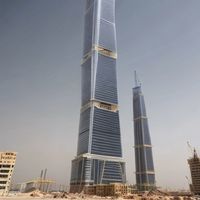
After a nearly seven-year hiatus, construction on the Jeddah Tower in Saudi Arabia, poised to become the world's tallest skyscraper, has recommenced. The project, which was halted in the midst of a nationwide anti-corruption crackdown, is now set to be completed by 2028, as announced by the Jeddah Economic Company (JEC), the consortium spearheading the development, during a recent ceremony on the construction site.
The 1,000-meter (3,280-foot) tower, which was approximately one-third completed in 2017, faced a setback when key individuals, including the chairmen of the primary contractor and a company that co-financed the project, were detained as part of Crown Prince Mohammed bin Salman's anti-corruption drive. This campaign led to hundreds being questioned on corruption allegations. Despite the arrests, work briefly continued before coming to a complete stop in early 2018. Concerns over the economic impact of the purge, along with the disruptions caused by the Covid-19 pandemic, further delayed the resumption of construction.
This week's ceremony was attended by Saudi Prince Alwaleed bin Talal, one of the officials previously detained, who is also the chairman of Kingdom Holding Company, a major backer of the project. Alwaleed, a cousin of the Crown Prince, was released nearly three months post his arrest, with the reasons and conditions of his release undisclosed. Following the ceremony, Alwaleed shared a video on social media showcasing a digital rendering of the tower, captioned with a message indicating the project's revival: "We're back."
Another significant figure implicated in the anti-corruption campaign was Bakr bin Laden, chairman of the main contractor, Saudi Binladen Group. Bin Laden, who is also the half-brother of Osama bin Laden, was reportedly released in 2021, after three years of detention. His family's firm, which holds a stake in the Jeddah Tower project, has been reappointed to complete the construction. The new contract, valued at 7.2 billion riyal ($1.9 billion), has seen approximately 1.1 billion riyal ($290 million) paid out for work already completed. Presently, 63 out of the tower's 157 stories have been constructed.
While the recent ceremony marked the official announcement of the resumption of construction, satellite imagery provided by US-based Maxar Technologies two months prior suggested that work had already begun on site. In September 2023, MEED, a Dubai-based publication, reported that JEC had invited bids from contractors for the project, although the developer did not confirm these plans at the time.
Initially known as Kingdom Tower, the skyscraper began construction in 2013 with an initial completion date set for 2020. Upon completion, it will surpass Dubai's Burj Khalifa, currently the world's tallest building, by more than 500 feet. The Jeddah Tower, located in Saudi Arabia's commercial capital and overlooking the Red Sea, is designed to include office, retail, and residential spaces. The original plans, unveiled in 2011, also included a hotel, shopping mall, and the world's highest observation deck.
The design and building specifications have not been confirmed to have remained unchanged throughout the hiatus by the Kingdom Holding Company. The tower was designed by US architect Adrian Smith, who utilized the building's "three-petal" footprint and aerodynamic shape to address the significant technical challenges associated with constructing at such heights. Smith's Chicago-based firm, Adrian Smith + Gordon Gill, has described the tower's shape as "evocative of a bundle of leaves sprouting from the ground." The plans also feature an intricate system of 59 elevators, which the firm refers to as "one of the world's most sophisticated elevator systems."
Adrian Smith + Gordon Gill has not provided comments on the resumption of work. The Jeddah Tower is set to be the centerpiece of a broader 57-million-square-foot, $20-billion development known as Jeddah Economic City. In 2018, Hisham Jomah, then chief development officer of JEC, stated that the project was "transforming the mindset" of Jeddah, which has historically served as a gateway to the holy cities of Medina and Mecca. "Before the tower, this was not seen as a place for people to live," Jomah said, who has since passed away. "We are creating a self-sufficient city... so that you don't have to leave."

By Thomas Roberts/Dec 18, 2024

By Samuel Cooper/Dec 18, 2024

By George Bailey/Dec 18, 2024

By David Anderson/Dec 18, 2024

By Amanda Phillips/Dec 18, 2024

By Noah Bell/Dec 18, 2024

By Sophia Lewis/Nov 28, 2024
By Benjamin Evans/Nov 28, 2024

By Michael Brown/Nov 28, 2024

By Noah Bell/Nov 28, 2024
By Jessica Lee/Nov 28, 2024

By Sarah Davis/Nov 28, 2024
By James Moore/Nov 28, 2024
By Emily Johnson/Nov 28, 2024
By Elizabeth Taylor/Nov 28, 2024
By Daniel Scott/Nov 28, 2024

By Daniel Scott/Oct 22, 2024

By Sarah Davis/Oct 15, 2024

By Rebecca Stewart/Oct 15, 2024

By Grace Cox/Oct 15, 2024